
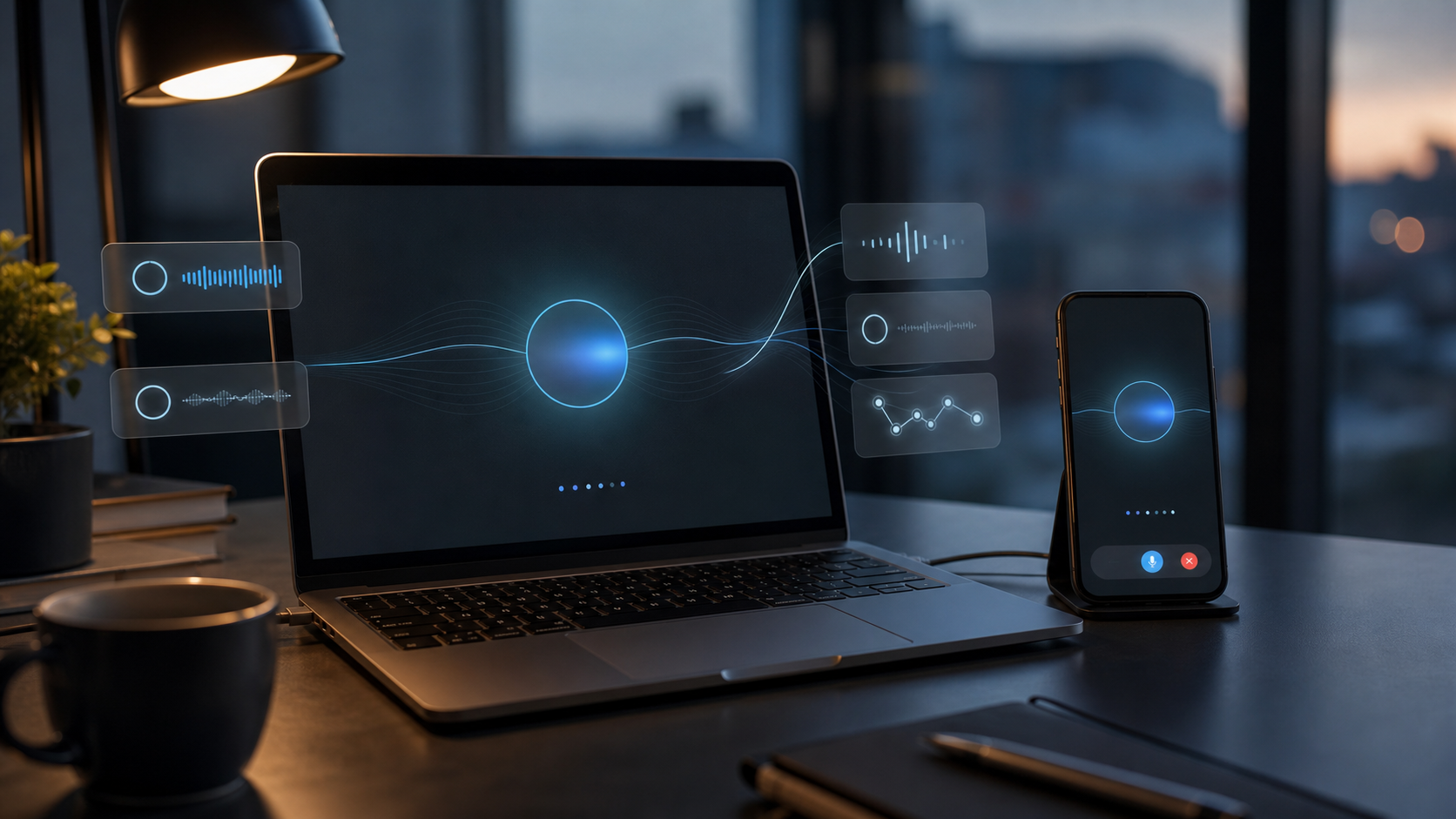
The real launch is not "voice got nicer."
The real launch is that ChatGPT Voice is no longer pretending conversation is a polite sequence of clean turns.
OpenAI’s new GPT-Live models are built for full-duplex interaction: the model can listen and speak at the same time, decide whether to keep listening, acknowledge you, pause, interrupt, or route work to another model while the conversation continues. That sounds like a product detail until you try to build with voice. Then it becomes the whole interface.
The old voice assistant pattern was basically a walkie-talkie with a better accent. You talk. It waits. It guesses you are finished. It replies. If you pause to think, it cuts in. If you interrupt, the system often treats the interruption as a new turn instead of a natural correction. GPT-Live is OpenAI’s attempt to break that pattern.
TL;DR
OpenAI launched GPT-Live on July 8, 2026. GPT-Live-1 and GPT-Live-1 mini are rolling out globally in ChatGPT Voice, with GPT-Live-1 for Go, Plus, and Pro users and GPT-Live-1 mini for Free users. The model is full-duplex, can handle more natural interruption and pauses, can show visual cards, can use search and memory, and delegates deeper work to GPT-5.5 at launch.
The important constraint: this is a ChatGPT Voice launch first. OpenAI says API access is planned soon, but the Help Center says Live is not initially available in Business, Enterprise, Edu, Temporary Chats, desktop app, Work, Codex, custom GPTs, video, or screen sharing.
My read: GPT-Live is the first ChatGPT Voice release that should make product teams redesign workflows around spoken interaction, not just add a microphone button.
What Actually Shipped?
OpenAI shipped GPT-Live-1 and GPT-Live-1 mini as the new models powering ChatGPT Voice. GPT-Live-1 is for paid consumer plans, while GPT-Live-1 mini is the default for Free users.
OpenAI’s launch post says GPT-Live is "a new generation of voice models" now powering ChatGPT Voice. The Help Center gives the operational split: Live is powered by GPT-Live-1 on paid plans and GPT-Live-1 mini on Free. The same Help Center page was updated minutes before this rewrite, which makes it the most useful source for availability details.
The core technical claim is full-duplex voice. OpenAI says GPT-Live continuously processes input while generating output, so it can make interaction decisions many times per second: keep listening, speak, pause, interrupt, or invoke a tool. The Verge’s launch report quotes OpenAI product lead Atty Eleti explaining the same point: GPT-Live can process input and output streams continuously and simultaneously.
That is the break from the older model family.
| Voice approach | How it behaves | What breaks | Why GPT-Live matters |
|---|---|---|---|
| Cascaded voice | Speech-to-text, LLM, then text-to-speech | Slow responses, lost nuance, stilted timing | GPT-Live avoids the chain for the live interaction layer |
| Turn-based voice | One model handles audio, but still waits for turns | Pauses and background noise can trigger bad interruptions | GPT-Live can decide whether to wait, respond, or keep listening |
| Full-duplex GPT-Live | Listens and speaks continuously | Harder safety and privacy problem | The interaction finally feels closer to human conversation |
This distinction matters because voice products fail in moments text products can hide. A text chatbot can take a few seconds and still feel acceptable. A voice system that talks over you, waits too long, or misses your correction feels rude or broken.
The Feature Is Not the Voice. It Is the Timing.
GPT-Live is valuable because it changes timing: interruption, silence, response pacing, and recovery.
OpenAI says the new Voice experience lets you interrupt with a question, pause to gather thoughts, ask ChatGPT to slow down, or ask it to stay quiet and listen. The model can acknowledge that it is following with small spoken cues like "mhmm" or "got it."
That last detail will sound trivial to people who only evaluate models through benchmark tables. It is not trivial. Spoken interfaces are emotional machinery. A quarter-second pause, a clipped sentence, or an unwanted interruption changes how competent the system feels.
The Help Center makes this concrete. It says Live can listen and speak at the same time, but also warns that overlapping speech, background noise, network conditions, and microphone settings can still affect what it hears. That is the right caveat. Full-duplex is not magic. It is a better control loop with real-world failure modes.
The most useful way to think about GPT-Live is this: it turns voice from command submission into shared attention.
That is why this launch is bigger than "ChatGPT sounds more human." The model is trying to maintain a live conversational state, not just convert your words into text and send a prompt.
The Quiet Architectural Move: GPT-Live Delegates Hard Work
At launch, GPT-Live delegates deeper tasks to GPT-5.5 in the background. That is the architecture to watch.
OpenAI says GPT-Live handles continuous interaction, while deeper work can be delegated to another model. At launch, that background model is GPT-5.5. OpenAI says it will update the model used by GPT-Live as newer frontier models are released.
This is the most important builder idea in the whole announcement.
Voice has two competing jobs. It has to feel immediate, and it has to be smart. Those are not the same requirement. If the same model has to handle live timing and deep reasoning in one path, the user either waits too long or gets a shallow answer. OpenAI’s answer is split labor:
- GPT-Live keeps the conversation alive.
- GPT-5.5 handles search, reasoning, or more complex work.
- The result comes back into the spoken flow.
That is not just a model launch. It is a product architecture for voice agents.
For builders, the pattern is obvious: use a fast interaction model for listening, acknowledgment, turn control, and conversational repair. Route expensive work to a deeper model or tool path. Then bring the result back without making the user stare into silence.
The product question becomes: can your app keep trust while work happens elsewhere?
What Users Get Today
GPT-Live is rolling out globally to ChatGPT Voice on iOS, Android, and ChatGPT.com. Paid consumer plans get GPT-Live-1; Free gets GPT-Live-1 mini.
OpenAI’s launch post says more than 150 million people each week use ChatGPT voice-related features such as Voice and Dictation. That is the distribution reason this matters. Voice is not a lab demo anymore; it is already a mainstream ChatGPT surface.
OpenAI says the new ChatGPT Voice experience includes:
- more natural interruption and pauses
- smarter answers through frontier-model delegation
- Instant, Medium, and High intelligence settings where available
- better focus on the user’s voice in noisy settings
- visual cards for weather, stocks, sports, maps, and similar structured answers
- support for search, memory, images, and file uploads where those features are available
The Help Center adds the restrictions that matter:
| Surface | Live status at launch |
|---|---|
| ChatGPT web and mobile personal accounts | Rolling out |
| Free users | GPT-Live-1 mini |
| Go, Plus, Pro | GPT-Live-1 |
| Business, Enterprise, Edu | Not available at launch |
| Temporary Chats | Not available at launch |
| Desktop app | Not available at launch |
| Work, Codex, custom GPTs | Not available at launch |
| Video and screen sharing | Not supported by Live at launch |
That last row matters. Advanced Voice still has mobile video and screen-sharing capabilities for eligible subscribers. Live is the new conversation model, but it is not yet the superset of every previous Voice capability.
What Builders Should Not Say Yet
Do not say GPT-Live is generally available in the API. OpenAI says it plans to bring GPT-Live to the API soon. That is not the same as shipping API access today.
This is where the earlier research went wrong. It blurred consumer ChatGPT Voice, older Realtime API releases, and unverified model names into one story. The fresh source set supports a cleaner version:
- GPT-Live is a ChatGPT Voice launch today.
- GPT-Live-1 and GPT-Live-1 mini are the model names in the launch.
- OpenAI says API access is planned soon.
- OpenAI’s Help Center says Live is not initially available in Codex, Work, custom GPTs, desktop app, or enterprise workspaces.
- Older Realtime API details should not be treated as GPT-Live API details unless OpenAI connects them in current docs.
That distinction is not pedantry. If you are planning a product roadmap, “available in ChatGPT” and “available through an API with pricing, model IDs, limits, schemas, and enterprise controls” are different facts.
Safety Is Now Real-Time Too
The GPT-Live system card says safety checks can happen while the conversation unfolds, including steering, interruption, spoken safety messages, support resources, or ending higher-risk conversations.
That is the necessary cost of full-duplex voice. The more natural the interface gets, the more the safety system has to operate in time, not just after a text answer is composed.
OpenAI’s system card says GPT-Live uses voice-native evaluations and red teaming across risks including self-harm, emotional reliance, scams, manipulation, impersonation, speaker identification, and audio-specific perturbations. It also says the models generally perform equal to or better than Advanced Voice Mode across adversarially selected safety prompts, while noting that two small regressions were not statistically significant: emotional reliance for GPT-Live-1 and sexual-content handling for GPT-Live-1 mini.
That caveat is worth keeping. The credible position is not “voice is solved.” The credible position is “OpenAI is moving safety into the live audio loop because voice makes the stakes different.”
The Help Center also gives the practical data-control detail: Live and Advanced Voice audio clips are stored with the transcript in chat history and retained for 30 days, while Standard Voice deletes audio after transcription unless the user has opted to share audio for model improvement. Users can choose whether to share audio or video clips for training, depending on plan and workspace.
If you are building around this, do not bury privacy state. Full-duplex voice asks the microphone to feel alive. That means consent, mute state, transcript boundaries, and retention policy need to be obvious.
My Take: This Is the First Voice Launch That Changes the Product Shape
The right comparison is not Siri. The right comparison is typing.
Typing made AI feel controllable because you could edit before sending. Early voice took that control away. It forced users to perform clean turns for a machine that interrupted at the wrong time.
GPT-Live tries to give control back in a voice-native way: interrupt, pause, redirect, ask it to wait, ask it to slow down, let it search while the conversation keeps moving.
That changes which workflows make sense.
Voice becomes good for:
- talking through ambiguous plans
- live language practice and translation
- coaching where interruption matters
- hands-free research triage
- support flows where the user needs to correct details midstream
- mobile use where typing is the bottleneck
Voice is still risky for:
- multi-speaker meetings
- high-stakes factual answers without visual/source confirmation
- environments with background speech
- sensitive conversations where retention and training settings are not understood
- enterprise workflows that need Live but are not supported at launch
The best product teams will not just add a microphone button. They will redesign the task around continuous interaction.
What To Do Next
If you are a ChatGPT user, test it on the failure cases that made old voice annoying: pause mid-thought, interrupt it, ask it to wait, ask for live translation, ask for a visual answer, and try it in background noise. The point is not whether the demo sounds impressive. The point is whether you feel less forced to speak like a command line.
If you are a builder, do not claim API availability yet. Instead, write the product spec now:
- What needs live interruption?
- What can be delegated to a deeper model?
- What must be shown visually instead of spoken?
- What does the user see when the model is listening?
- What happens when the model mishears?
- What data is retained?
- What is your fallback when Live is not available?
GPT-Live is not the end of the interface transition. It is the point where the old turn-taking metaphor starts to look obsolete.
The microphone is not the feature anymore.
The feature is shared time.